


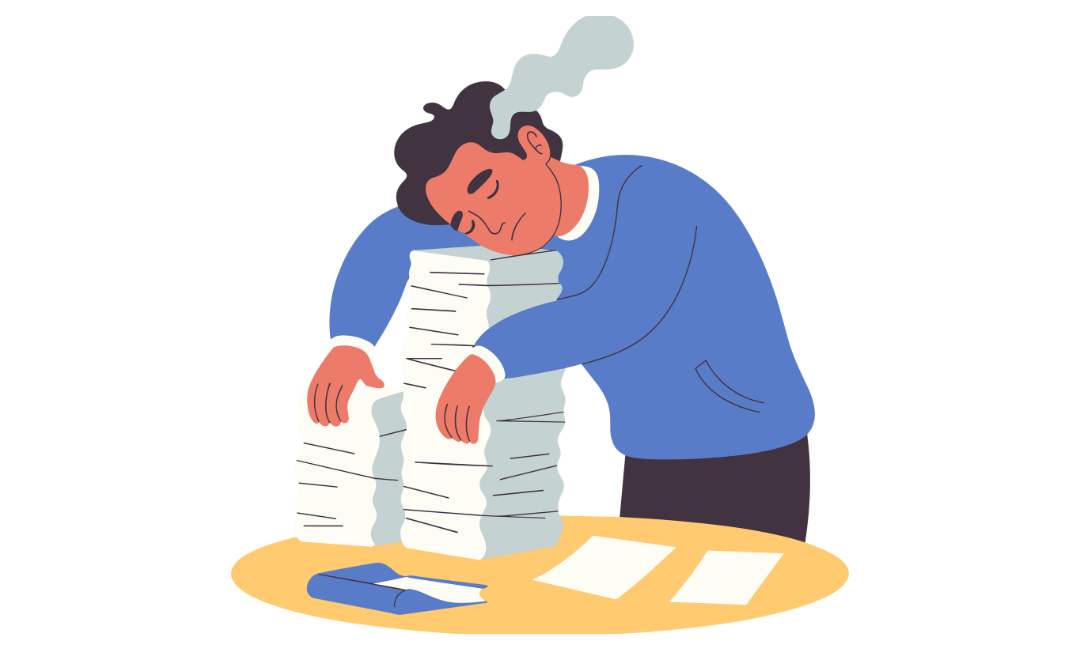
Today, in therapy, more and more people say:
“I can’t cope anymore.”
“Things that used to feel routine now require enormous effort.”
“I feel anxiety, shame, and emptiness.”
These experiences are often grouped under a single term — professional burnout.
Although many clients describe similar feelings — fear of losing their job, a sense of personal inadequacy, despair — an attentive therapist understands that a diagnosis is only a reference point, the visible tip of an iceberg. Beneath it lies the unique personal history of each individual.
What causes burnout, and what happens to the psyche during this process?
In this article, I will explain the mechanisms behind this condition and outline directions that can help begin the path toward restoring psychological balance.
Your Mind Is Not Broken — It Is Protecting You
Let me begin with the most important point.
Even if it feels as though you have lost yourself —
even if you no longer recognize the person you once were —
even if you feel ashamed of your current state —
you are not broken.
Your psyche is trying to protect you.
Burnout as a Loss of Inner Balance
If I were asked to describe the essence of burnout in a single sentence, I would define it as a loss of inner balance.
We live in an era where external achievements and measurable productivity increasingly become the main — and sometimes the only — criteria by which a person’s value is judged. Under such conditions, people may gradually lose connection with their natural rhythm, their feelings, and their genuine needs.
When a person spends a long time trying to meet excessively high expectations, pushing beyond their psychological and physical limits, the organism eventually reaches a point where continuing to function in the same way becomes impossible without serious consequences.
At that point, the psyche activates its protective systems.
Burnout is not weakness.
It is a signal from the system that the previous way of living is no longer sustainable.
When the Survival System Activates
From this moment on, the brain begins to function differently.
It perceives the situation as a threat to survival and starts constantly searching for a way out. This process becomes continuous.
Thoughts become intrusive. They return again and again — even at night, even when you try to rest.
Your internal alarm system has been activated.
The Biology of Burnout
When a person perceives a situation as threatening, a series of biological reactions occurs in the body.
The amygdala, a brain structure responsible for detecting danger, sends signals to the hypothalamus, activating the sympathetic nervous system. The adrenal glands release cortisol and adrenaline — hormones that prepare the body for the classic survival response: fight, flight, or freeze.
The brain enters a state of heightened alertness. Attention automatically focuses on possible threats, while repetitive anxious and intrusive thoughts arise.
This mechanism is a natural part of the human survival system and normally helps a person adapt to danger.
However, when stress persists over a long period of time and the hypothalamic–pituitary–adrenal (HPA) axis remains chronically activated, the nervous system gradually becomes exhausted.
A person begins to experience constant tension, a loss of inner stability, and psychological depletion — the state we recognize as burnout.
The Self-Reinforcing Cycle of Burnout
Burnout tends to intensify itself.
Reduced concentration and energy lead to decreased effectiveness.
This, in turn, increases internal criticism and anxiety.
Anxiety further heightens nervous system tension, which then worsens cognitive functioning.
Additional secondary experiences often emerge:
- shame about one’s condition
- fear of one’s own anxiety
- loss of a sense of competence
- feelings of helplessness
Because of shame, many people begin to withdraw from others, avoid communication, and hide their state.
Yet isolation deprives them of one of the most important resources for regulation — support through human connection.
Thus, a self-reinforcing cycle forms in which the symptoms amplify one another. Without timely support, this state may develop into severe depression.
The Inner Critic
People with a strong inner critic — what psychoanalysis describes as a harsh superego — are particularly vulnerable to burnout.
These are individuals who:
- are accustomed to carrying responsibility
- tend to search for the causes of difficulties primarily within themselves
- hold themselves to very high standards
- rarely allow themselves rest or weakness
When such people begin experiencing exhaustion, anxiety, or a decline in productivity, the inner critic interprets this as a personal failure.
Thoughts appear such as:
“I’m not coping.”
“Something is wrong with me.”
“I’m losing myself.”
“I’m no longer the person I used to be.”
These experiences undermine inner stability.
A person may feel as though they are standing in an internal courtroom where the prosecutor speaks loudly and convincingly — while no defender is present.
One of the important roles of psychotherapy is to temporarily provide this inner ally — someone who helps a person see their condition not as a personal failure but as a natural result of prolonged strain created by excessive demands and pressure from the professional environment.
The Role of Personal History
Past experiences involving shame, devaluation, or the constant need to meet expectations can create heightened sensitivity to situations involving evaluation, performance, and recognition.
When current circumstances activate earlier emotional wounds, a complex interaction arises between past and present.
Biological mechanisms of anxiety, psychological defense strategies, and personal history intertwine, creating a state that many people experience as a loss of themselves.
The Path to Recovery: Returning to the Inner Center
Recovery does not begin with effort — it begins with stopping.
The first step is slowing down.
This may feel paradoxical because internally the situation is experienced as a threat that requires immediate action. Yet continuing to operate in the same mode is precisely what sustains exhaustion.
Slowing down becomes an act of reconnecting with oneself.
It can begin with very simple things:
- noticing your breathing
- feeling the sensation of water on your skin while taking a shower
- tasting your morning coffee
- allowing yourself a few minutes of presence in the present moment
These simple bodily anchors help the nervous system move out of the constant threat response.
Restoring Balance as a Process
Burnout develops when a person spends too long living under conditions that do not correspond to their inner rhythm and psychological nature.
Recovery is a gradual process of returning to one’s internal center.
It includes:
- restoring contact with one’s feelings
- reducing the power of the inner critic
- developing internal support
- learning to respect one’s own limits
- finding a more sustainable balance between external demands and internal needs
This is not a quick process.
But it is a process that returns not only the ability to function, but also the sense of authorship of one’s own life.
The Role of Psychotherapy
Psychotherapy creates a space where a person can be seen and understood without judgment.
It is a space where, gradually, an inner ally begins to emerge — a more supportive and alive part of the personality.
Recovery begins when a person stops fighting themselves and begins to listen to themselves.
Within every person there already exists a point of inner support. Sometimes it becomes temporarily lost under the pressure of prolonged stress and overload.
The task of psychotherapy is to help a person find the way back to it.